Now Reading: [Cover Story] Where The Festive Season Gently Unfolds At A Little Farm On The Hill
-
01
[Cover Story] Where The Festive Season Gently Unfolds At A Little Farm On The Hill
[Cover Story] Where The Festive Season Gently Unfolds At A Little Farm On The Hill


The year stretches open and the festive season continues its gentle rise on A Little Farm On The Hill, where celebration is shaped by sunlight, story, and the kind of food that brings people back to one another.
Forty-five minutes northeast of KL, as the city hum finally recedes, a small seven-acre farm on the hills of Janda Baik appears like a constellation of impressionist fragments. A perfectly sketched canopy of rainclouds hangs, suspended over a verdant, abundant patchwork of vegetable gardens. Timber pavilions, defined by the architectural restraint of clean minimalist lines, dot the gentle slopes. Fruit trees bow under the weight of ripening fruit.
The air here is cooler at the edges, carrying the scent of wet soil, the faint musk of sage. There is a tranquility so complete that the delivery of this luxury is almost a religious experience. One breathes deeper in this landscape, stands taller, and listens closer. You quickly realise you have stumbled into one of Malaysia’s most elegantly disguised dining experiences, where communal eating is a finely cultivated tradition.
The supper club that could

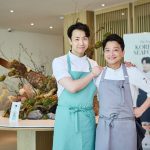
A Little Farm On The Hill (ALFOTH) began 11 years ago as a pragmatic dream: a farm that needed to sustain itself. “You won’t find our produce in the supermarket. We supply our harvests to the top 20 restaurants in the country. So it’s likely that you’ve eaten what we’ve grown, but just don’t know it,” says Pete Teo, one half of the couple that owns ALFOTH. And so, Lisa Ngan—trained architect, exceptional cook, orchestrator of spaces—and her husband Pete—musician, actor, creative satellite with a
gravitational pull all his own—decided on a monthly supper club. Just 20 guests max. Two people in the kitchen. One seating. One menu. One leap of faith. Their reasons were both economic and instinctive. It wasn’t a hobby. It wasn’t a business plan. It was simply what made sense. “We supply to the best restaurants, and now we’re among one of them ourselves,” Pete adds proudly.
They were not by any conventional measure, ‘restaurant people’ or the like. But their lack of culinary orthodoxy was precisely what made the early meals magnetic. Their creative backgrounds meant that they tackled every problem sideways: not ‘the industry way’, but the way that felt true to them.
The couple approach the culture of eating like designers and true creatives: what is the narrative? What is the rhythm? What is the emotional temperature of a room at 12:42 PM on a Sunday? Space matters to them, as do proportions and the honesty of materials, and the choreography of movement through a place. The way sunlight wanders across timber at lunchtime, the sound of footsteps on gravel, how a flirty breeze teasing curtains tenderly murmured “home”. Lisa’s architectural instincts are what shape the subtlety of how people move from the lunchroom into the gardens; Pete’s creative restlessness shape the progression of their narrative: a thoughtful intention of almost puritanical worship of form and function.
With space as narrative, we see books and flowers artfully placed, meals as performance, hospitality as something shaped from the guest’s point of view. Challenges are approached with logic or artistic intuition. What’s resulted is a lunch experience crafted as they would a story—with anticipation, release, surprise, and comfort.
Food matters hugely to them not as displays of extravagance, but in the thoughtful, curious way of people who travel widely and eat voraciously. An almost humble expression of land, season, and community. They have no culinary agenda, no desire for the pomp of fine dining. And so, the supper club grew gently; one delicious, deeply personal meal at a time. It grew not through marketing, but through that most Malaysian form of publicity: people talking while eating good food.
Reinventing the farm

From the outset, Pete and Lisa only knew that they wanted to establish an organic farm where people wanted to work. “No ego, no pretence. Just values.” They grow over 40 varieties of vegetables, herbs, edible flowers, and fruits with a deep respect for soil, space, and life. This farming, rooted in regenerative practices, prioritises soil health, biodiversity, and environmental stewardship.
“In a world going through climate change, the importance of keeping our soil healthy cannot be understated. It is our core value. It sounds like esoteric organic-farmer-speak, but it is in fact the most important thing that we do,” informs Pete. “In fact, we don’t even think of ourselves as growing vegetables; we think of ourselves as growing soil.”
As Pete mentioned, the bounty yielded here has now extended its reach to the city, with many of KL’s top restaurants—names held in reverence by the city’s food community—glad recipients. Walking through the grounds one sees terraces of vegetable beds, fish ponds, a cluster of greenhouses stitched together by paths of earth, sculpted with care. The farm also offers workshops on the aforementioned soil health, fermentation, flower growing, and botanical dyeing.
Farm buildings are simple constructions of brick, wood, and steel. There is coherent deliberation in the ordered simplicity of a suspended wooden bench, racks of rebar, and flippable tables. It is all a part of a subtle design language that whispers “sure this is home, but let’s make it art.”
Looking ahead, ALFOTH prepares to deepen this very same third pillar: the arts. First up: an American painter who will be arriving soon to take up residency in the apartment they have built above Pete’s recording studio. “The studio allows me the freedom to do arts projects unfettered by commercial considerations. It will also be the centrepiece of the arts programmes we plan to roll out at the farm.”
Talks will soon follow. Then podcasting comes. Regular arts events. A way of giving back and honouring people that should matter. Those who, like themselves, root in quiet creation.
Waiting to exhale

The year 2022 marked the world’s tentative exhale. A cautious return to gathering, celebrating, remembering to be festive. ALFOTH leaned into it. By the time interstate travel flagged off, people were chomping at the bit, eager to drive up the hill for the privilege of being fed by two creative oddballs with a dream and very good produce. Once a month expanded into regular weekend Farmer’s Lunches. Wait lists thickened like those Malaysian rainclouds.
By December that year, ALFOTH unveiled their first month-long Christmas menu modelled on the classic tableau of British colonial nostalgia: turkey, stuffing, brussels sprouts, and a trifle as iconic as the season itself. ALFOTH executed this with the sincerity it needed to make the nostalgia feel earned. And even at the expanded scale, the supper club DNA held steady. Everyone ate at the same time. If anything, it felt like sharing a meal at Pete and Lisa’s home.
Fast forward to Christmas 2025. This most recent month-long menu has undergone tropical enlightenment. Affectionately monikered Fat Santa’s Festive Table, the year-end feasting at ALFOTH is a celebration that rejects winter cosplay and embraces the humid, fruit-scented personality of this land. It’s festive without the forced jolliness, Malaysian without the clichés, sophisticated without the snobbery.
And if December marked a tentative exhale, January doesn’t close the book. For us Malaysians, the festive season isn’t a date on a calendar but an overlapping choreography. Christmas here simply fires the starting pistol; what follows is a procession of reunion and revelry that stretches into Valentine’s Day, Chinese New Year, the quiet discipline of Ramadan, and the luminous generosity of Hari Raya Aidilfitri. Festivity, in this part of the world, is less an ending than a rhythm. So while this story begins in tinsel and turkey, it lives on in the months that follow. Celebration is our climate, not our season.
Festive Feasting

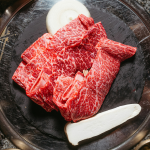
Over-indulgence isn’t the reason for the season, but it’s definitely an essential ingredient. A glorified hunk of protein has always seemed central to any feast and to this end 2025 saw ALFOTH offering lamb, duck, and chicken alongside their trademark beef (a tomahawk Wagyu) across its two menus. There is a Christmas Day menu (A Little Farm Christmas) and the month-long Fat Santa’s Festive Table.
What’s on the menus are super juicy lamb chops marinated in spices before they are deep fried. Working beautifully with the two accompanying sauces: hot papaya that’s sweet and spicy, and a piquant green peppercorn yoghurt, we are loving this nod to Christmas colours. Then there are duck legs, sourced from a small farm in Perak. Firstly spiced, salted, then confited, they finally finish on a grill before being served with nutmeg jam made from the farm’s orchards. The organic chicken is first dry-aged before roasting on high-heat for a wonderfully crisp finish, that prized skin glistening on a bed of lentils.
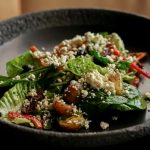
Both menus are a tour de force. The grazing platters are a sun-dappled riot of cold cuts with melons from a Terengganu farm. A sweet, crisp, delightful pairing that makes tropical sense. The 12 leaf salad which appears weekly on the Farmer’s Lunch menu possesses an alchemy yet to be replicated anywhere else. Many have tried with no success. Is it the dressing or just magic in the soil that grew these leaves? The aubergine arrives charred, a velvety indulgence enlivened by farm-made nduja, crafted from duck breasts that once belonged to those legs.
“My favourite item on our recent Christmas menu is the chocolate clafoutis,” Lisa proclaims. “It was immediately a star in research and development. Rich and fruity and naughty. It’s exactly what you’d want in a Christmas dessert. We are really excited to serve it.” It arrives warm, slow, and unapologetically dramatic. A scoop of plum ice cream slowly melting over it. Finally, the mulled wine of cold climes has been pulled off the menu. Replaced cleverly by roselle tuak. A fermented, floral, liquid wink to our rice eating roots.
As December’s first advent door swings open, tables at ALFOTH will brim with a dozen courses passed around and shared. Loudly and lovingly. A Malaysian Christmas meal—familiar, comforting, and reinvented to be irreverently and boldly new. A beautifully presented feast layered with indigenous flavours, seasonal produce and the quiet poise of a kitchen that knows its land. And if their Christmas table is any indication, then the months ahead feel ripe with promise.
A kitchen of 16, a conversation of many

ALFOTH now runs with a crew of 16 guided by head chef Wei Jian who leads with the calm confidence of someone who knows that the ingredients are doing half the heavy lifting. Though perhaps the word “crew” seems insufficient to describe the creatives, the technicians, and the culinary philosophers that keep this place running. Four members of staff are trained fine-dining chefs, and all are cross-trained to move gracefully between kitchen and front of house as needed. The team is mixed bag of personalities assembled from a complex matrix of technical brilliance and emotional compatibility. People who can live on a farm, who value honesty, who work hard and who treasure the community they’ve created.
Menus are created through long, meandering conversations and passionate discussions. A process of collective introspection with tough questions asked by philosophical provocateur, Pete, and Lisa. “Why does this dish deserve a place on the table? Does it deserve to exist almost an hour out of the city? What is Christmas to someone who has never celebrated? Why turkey? Why must it always be turkey?” The collaboration here is an ingredient as essential as salt. Or soil. In the end, they realise, what matters the most is memory, nostalgia, and a sense of occasion. But also the Malaysian instinct for gathering with food that invites participation rather than reverence. This shared instinct to reach across the table and feed each other with not only food, but ensure a sense of belonging and feeling of closeness.
The cooking today has definitely become more technical—layered, confident, deeply considered—yet still unmistakably ALFOTH. “It’s not dotty and foamy,” Pete reminds me. “It still looks like food you want to eat, and not just photograph.”
Behind the scenes, the kitchen is an ecosystem of craft. Chickens are brined for 24 hours, duck breasts cured before becoming nduja, stocks simmer for up to 48 hours, vegetables are harvested mere hours before cooking. Ferments bubble quietly in the background. The smoker—an imposing metal creature that looks equal parts spaceship and sculpture—labours through the night.
Though some dishes may no longer be easily replicable in a home kitchen, they remain accessible in spirit. Hearty, wholesome expressions of who we are as Malaysians—a tropical, multicultural country with centuries of culinary history simmering in our soil.
A Malaysian institution
Today, ALFOTH is no longer a secret whispered among food-obsessed friends. It is, unmistakably, one of Malaysia’s most sought-after reservations. A village gathering in hilltop form. A farm-to-table restaurant that features in the top tables of the nation. A place that regularly appears on ‘Best Of’ lists and inspires the sort of urban devotion usually reserved for hard-to-get omakase counters. They operate four days a week: private bookings on Thursdays and Fridays, followed by the now-legendary Farmer’s Lunches on the weekends.
What began as a once-a-month experiment has become a cultural landmark—an award-winning, always booked, rigorously personal expression of how Malaysians can eat together. And why food matters.
For many city dwellers it has become a place of pilgrimage. One earmarked for birthdays and weddings and anniversaries. ALFOTH draws in a crowd who understands the reality of what food is in Malaysia. That we do not eat along geographical lines. It’s as uncomplicated to us as how tasty and accessible anything is. Because it is normal to us to have multiple cultures represented on one table. It just needs to be very, very good food. We too take a bow as guests—always a part of the whole performance. Because ALFOTH quite simply makes you feel stylish just by sitting at a table.
But perhaps the best of ALFOTH is still the unexpected stuff. The things that aren’t plated or framed or advertised or sold. It’s the way strangers arrive with polite smiles and might leave as friends. The way the fields whisper their proximity to the plate in every bite. The way the entire space, from the hills to the birdsong, feels like it belongs to just you if only for a few hours. It’s cultural, natural, deeply familiar. But most importantly, it’s magical whatever season you choose to be here.
Photography: Trisha Toh and Billy Simon
Conceptualised by: Shireen Zainudin and Viji Krishnamoorthy for Have You Eaten?
*This article was first published in the January – March 2026 issue of Palate.
A Little Farm On The Hill