Now Reading: Cooking The Past Into The Present: Karen Yap Champions Sarawak’s Culinary Heritage
-
01
Cooking The Past Into The Present: Karen Yap Champions Sarawak’s Culinary Heritage
Cooking The Past Into The Present: Karen Yap Champions Sarawak’s Culinary Heritage


The kitchen is where Karen Yap found her voice—not just as a chef, but as an advocate for Sarawak’s food culture. This goes beyond just dinner; it’s a mission to showcase and hopefully save what’s being lost before it’s too late.
I get in touch with Karen, hoping to set an appointment to speak that week. She’s busy, she tells me. But wait, she has an idea. She’s currently preparing a private dinner for the International Wine & Food Society. Might they be alright with me being a fly on the wall? She’ll ask. The next day, Karen shoots me a text: I’m in. It’s the perfect opportunity to see Karen in action up close and personal. The anticipation lingers in the back of my mind over the next week, sometimes edging its way to the forefront of my thoughts.
The day arrives, and I hop out of my car to meet the industrial surroundings of the Tong Ah Distillery. A quick check with the guard, and I make my way into the grounds. Outside, I spot a gentleman grilling duck breasts—one of Karen’s helpers for the evening. I head inside the century-old distillery, taking in the scene.
You get the sense that not much has changed since its inception, a quality I appreciate. The expansive, warehouse-like interior is alive with a group of people, mingling over glasses of interestingly-hued elixirs. I make my way to the front, where a table is laid out with all manner of potions, each with its own label and origin story.
Soon enough, the third-generation steward of the distillery steps up with a mic and charming little speaker, gathering everyone around for a tour. All around me are boxes and pallets piled high with wine. The echoes of the past resonate through the high-ceilinged, white-walled corridor.
Dinner time arrives, and I, the lone outsider, find myself seated at the head of the middle table. After a considerable effort to shed my social anxiety, I settle in to enjoy what Karen has prepared. The first course is a trio of mini bites served on a wooden board. I notice that everyone’s board is slightly different in shape, a sign they were carved by hand.
I start from the left and bite into the umai of snapper with a handcrafted sagu crisp. The fish has a gentle tang and is soft on the palate, while the crisp tastes almost exactly like soft keropok. Next is the kasam of sultan croquette with pineapple cincalok, which throws me for a loop. It’s pungent, almost like a strong cheese. We’re served a glass of Endu sparkling tuak to pair with the meal, and its slight dryness cuts through the intensity of the croquette.

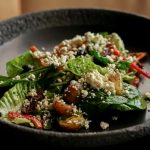
The terung iban and tahai salai consommé follows—a clean-tasting dish with just a touch of bitterness. Karen explains that she uses terung iban because it’s sour, unlike other aubergines. The asam siok comes next, gently spiced with jungle aromatics and topped with a bamboo-fired quail egg.
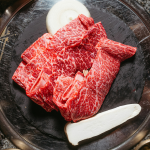
A few more interesting courses later, it’s time for the main dish. Karen has arranged for me to try the Narar of beef brisket—lightly salted with a smokiness in the background, reminiscent of bacon. The texture has just the right amount of chewiness to it.
After experiencing Karen’s culinary mastery firsthand, I head home, heady in the warm afterglow of a dinner well spent in great company, enjoying a cuisine unlike any I’ve ever had before. My eagerness to speak with Karen has only grown.
Table talk

Tuesday rolls around, and I arrive at Karen’s home. The cool grey walls greet me, followed by scattered foliage. Mia, her nine-year-old rescue German Shepherd, lies outside. I ask if I can pet her, and Karen obliges. Mia seems to enjoy the attention.
Karen welcomes me inside, where we sit at her kitchen table, positioned between the living room, kitchen, and courtyard. She’s relaxed in an airy sundress, her hair streaked with dignified grey, her smile radiating a restrained ebullience. To me, she embodies every bit the archetype of that one cool aunt you actually don’t mind a visit from. We begin our conversation, and I keep my questions loose, letting the conversation flow naturally.
I ask what inspired her to leave the corporate world and dedicate herself to hosting ethnic dinners. She tells me it wasn’t planned—it was a natural extension of what she’d always done, coming into contact with an opportunity by chance. She’d always been cooking, just for friends, until one day a friend who had opened an event space suggested she try setting something up.
“I’ve always been cooking food and our ethnic food, but just for friends,” Karen says. “One of my friends had started an event space off Old Klang Road, and he said, ‘You know what? I have this space—why don’t you try and do something?’ And it was because I missed my food, my culture. That was the start of a very different trajectory for me, leaving the corporate world to focus on this.”
Karen’s passion for what she does is palpable. She talks about her childhood spent in a longhouse, where life was simple, and the connection with nature was strong. It’s these fond memories that infuse her current work. “The food carries so much more than just taste,” she explains. “It carries the showcase of the ingredients, the environment in which these foods came about. It comes with a narrative of how people lived and how we try to preserve those ways of living.”

She speaks of the slow erosion of once-celebrated traditions and her role in trying to halt that decline. “We don’t cook the way we used to cook. Those recipes are slowly being forgotten and lost,” she says, her voice tinged with wistfulness.
Karen emphasises that the loss of these traditions isn’t anyone’s fault but rather a consequence of rapid urbanisation. “It’s not that we deliberately lost sight of our culture. The fast pace of urbanisation left that generation with other pursuits. You can’t fault them for that.”
However, she sees signs of hope. Young people today, especially in East Malaysia, are reconnecting with their culture. “I feel that there’s this reconnection now,” she says. This recognition of East Malaysian culture, especially Sarawakian food, is a key focus for Karen. She points out how the majority of people in Peninsular Malaysia only know a couple of dishes from Sarawak: Kolo Mee and Laksa Sarawak. “Both of these dishes, as much as I love them, are migrant dishes brought by the Chinese. And they’ve become the most identifiable thing about Sarawakian food,” she says.
Karen wants to broaden the perception of Sarawakian cuisine beyond these two dishes. “We’re so much more than that,” she asserts. “I make them regularly at home, but I always tell people that there’s so much more to Sarawakian food.”
A cultural kitchen crusader

Doing something so far removed from her previous life, striking out on her own, and carving an uncharted path has transformed Karen. I ask her how this journey has changed her, and she falls into a reflective silence. “It’s gone beyond just cooking food, showcasing it, and sharing it,” she says. “I see myself more as an advocate for the cuisine now.”
Taking on this role is no small feat, but Karen is determined. “I want to see my journey replicated by younger generations,” she says, her voice full of hope. Though unsure how that will materialise, she remains resolute. “I see so much potential in this current generation,” she smiles. “They’re participating as much as they can.”
Karen may not know exactly what the future holds, but one thing’s for sure—it’s bright.