Now Reading: [Cover Story] Two New Michelin-Starred Restaurants Are Here To Shake Up The Fine Dining Scene
-
01
[Cover Story] Two New Michelin-Starred Restaurants Are Here To Shake Up The Fine Dining Scene
[Cover Story] Two New Michelin-Starred Restaurants Are Here To Shake Up The Fine Dining Scene


Two Michelin-starred restaurants led by Aidan Low and Chong Yu Cheng are at the forefront of Malaysia’s evolving fine dining scene.
It’s fair to say the Malaysian gastronomic scene has come on in leaps and bounds. Where fine dining was once characterised largely by European mimicry or hotel dining rooms, it has since evolved into something far more compelling: chef-driven, identity-led cuisine. This forward movement has been charted by some heavyweight names, not least the inaugural recipients of Michelin stars in the country—the two Darrens, Chin and Teoh, whose establishments laid down a marker for KL as a legitimate fine dining destination—as well as Su Kim Hock and Bee Gaik Lean, who carried the torch for Penang.

In their wake, a constellation of new talents has emerged with their own distinct takes on food. Two of the brightest belong to Aidan Low of Akar and Chong Yu Cheng of Terra Dining, more commonly known as YC. Along with their newly minted Michelin stars, the pair also share the spotlight as the cover stars for this issue.
It is something of a quirk of circumstance that their restaurants—located just a few doors apart—received their stars on the very same day. Two freshly anointed Michelin establishments, led by a headstrong pair of chefs from wildly different backgrounds, standing in such close proximity? It has all the makings of Netflix’s next fiery culinary drama. The reality, however, is far less combative. Despite their differing educations, both men share remarkably similar ideas about what food should represent. They also happen to be good friends.
Lights, camera, kitchen

It’s a temperate Tuesday morning when the shoot begins at Terra. Stepping out of my car, I’m greeted by the restaurant’s discreet entrance—a terracotta-toned façade framing a heavy wooden door and the small “T” logo. Inside the lounge, the first thing to catch my eye is a roughly 70-year-old pestle and mortar illuminated beneath a soft spotlight. The second is the unmistakable red star with a heart in the corner—that small badge of approval that most restaurants can only dream of displaying on their shelves.
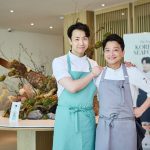
The lounge looks much as it usually does, except today it’s cluttered with the paraphernalia of a photoshoot. Light stands, softboxes, and cables render space to manoeuvre at a premium. Picking my way through the equipment, I turn the corner to find the shoot in full swing. A cluster of tripods and crew members surrounds a wooden island, and at the centre of it all, leaning with easy composure against the warm grain of the timber counter, are YC and Aidan, angling themselves this way and that to sate the hunger of the clicking shutters.

I peer over to see that the photos come out swimmingly, with the first of them being a study in camaraderie. It features YC and Aidan leaning against the textured, sand-coloured walls of Terra Dining. Clean and stripped-back, the shot captures them grinning at something just off camera, lending the image a faint hint of voyeurism. It proves to be the perfect opener and sets the relaxed tone that would come to characterise the rest of the shoot.
Another image, this one altogether more striking, is a double-page spread of the duo midmeal. It’s a deliberate departure from the typical buttoned-up chef portrait, capturing the pair illuminated by a harsh cinematic flash as they dig into a spread of noodles, fried chicken, and local favourites with messy, joyful abandon.
The solo portraits, however, offer a more measured perspective. YC is captured in a moment of silent reflection, dressed in a sharp suit and looking off-camera—a stark contrast to his usual habitat in the heat of the line. Later in the spread, he appears in his element, navigating the kitchen with the focused intensity of service.
Aidan’s portraits, meanwhile, show him seated in gentle repose within his own restaurant, perhaps illustrating the calm before the proverbial kitchen storm. But subsequent frames emphasise the technical precision of his craft, with one particularly atmospheric image capturing him working the pass, plating a dish beneath the clinical glow of the kitchen lights.
When the shoot wraps, we head to the back of Akar to sit down for the conversation that would eventually become what you’re reading now. It has been a long day, but the two chefs appear no less energised than they were that morning.
From Nagano to Alsace
Their backgrounds, as mentioned earlier, could hardly be more different. To hear them recount it, however, really begins to illustrate the many trajectories a career like theirs can unexpectedly spring from. For Aidan, the signs were visible from childhood. At family gatherings that inevitably revolved around food, he could often be found hovering around the kitchen instead of horsing around with his cousins.

“I think at around 11 or 12 years old, I’d already decided I really want to make food my profession. I’m not sure how I came to that conclusion, but I figured it wasn’t just a hobby at that point,” he says. By 15, he had already enrolled himself in a culinary programme, setting in motion a journey that would eventually take him through two of the great bastions of fine dining: Japan and France.
“So I figured, okay, let’s see what Japan has to offer. I went there, spoke zero Japanese, chose a small town just outside of Nagano, which is quite unusual because there people don’t really speak English as well. So I picked up the language in two or three years and hopped through a few restaurants as well. I kept busy in the kitchen and then landed myself in a school in Osaka, which I think is one of the top culinary schools in the world.” The school in question was the Tsuji Culinary Institute in Osaka, one of Japan’s more formidable culinary schools.

After travelling around the Land of the Rising Sun for a time, Aidan eventually made his way to France—specifically Kaysersberg in Alsace—where he trained under Olivier Nasti at the two-Michelin-starred Le Chambard. “It was a very nice experience, but it was a very challenging one as well. It’s a small town and everybody knows everybody. I was the only Asian guy there. Where I go, what time I sleep, when I do my shopping. Everybody would know.”
Eventually, he returned to Malaysia. After working in a few establishments, he launched Akar as a pop-up. The concept gradually grew into a permanent restaurant, though not without its trials—the arrival of COVID-19 just nine days after opening, not least among them. Six years on, Akar now celebrates its first year as a Michelin-starred establishment.
The unlikely chef

YC’s route into the culinary world was decidedly less direct. “I guess food was never something that I thought would be my profession, even up to the point where I opened a restaurant,” he says with a laugh. “So I’m the other way around. I opened a restaurant before I knew how to cook, which is unconventional, to say the least.”
Originally trained in accounting—a decision rooted in pragmatism and driven by the prospect of obtaining an Australian permanent residency—YC eventually realised the drudgery of a nine-to-five wasn’t for him. Returning to Malaysia, he drifted his way through a number of professions before hospitality entered the picture.
The turning point came when plans were set in motion to open a wine bar in Ipoh. Everything was going smoothly until the head chef abruptly resigned—followed shortly by the rest of the kitchen team. What followed was an unexpected crash course in cooking.
“So they gave me one month’s notice,” YC recalls. “And I was like, sure, yeah, I’m not going to keep you. You want to leave, I can’t keep you. But in that one month, you still have to serve your notice, and I will be your intern. I will go to the market with you. I will buy things with you. I will learn how to fillet a fish, how to debone a chicken, that sort of thing.”
He takes a moment to revisit the chaos of the time. “In that one month, I had to pick up everything, and then I was left pretty much on my own, other than my current sous chef, Sean. So he came into the kitchen with me, and we started from there.”
With neither of them formally trained, the pair operated with a certain creative freedom. “So because none of us at the time were culinarily trained, we were not boxed into a French or Japanese or Italian cuisine. It was just whatever we could think of. Whatever we wanted to experiment with, we just did it.” Eventually, as the pair gained confidence, the restaurant expanded from simple café fare into dinner service. As was the case with many establishments, though, the pandemic forced repeated resets of the team.

By 2022, things had stabilised, but YC, as is a running theme in his life, found himself mired in the clutches of boredom. “I was like, okay, I probably need to leave the country and go to a real restaurant to learn. But I didn’t see any restaurant in Malaysia I could really benefit from. Also, I felt that I needed to be put in a completely new environment. And that way, I can’t fall back on family. I can’t fall back on friends.”
By what he deems sheer luck, he secured a stage at Frantzen, the boundary-pushing three-Michelin-starred restaurant in Stockholm. It was a stint that would prove to broaden his culinary and personal horizons on an immeasurable scale. It was while he was there, taking shape within the crucible of just about the finest practical education a young chef could hope to receive, that his sister called with news of an available shop lot in TTDI.
“She gave me a call and said, “I found a shop in TTDI. Very hard to come by. Rental is reasonable. Do you want to take it?” And I said, okay, right, I’ve no idea what the hell I’m going to cook, but let’s sign the lease.” And so Terra was born.
Blurred Lines
For all their differences, the two chefs have arrived at not entirely dissimilar destinations—geographically speaking, at least. Asked to describe what they actually do at their restaurants, Aidan takes a pensive gap before answering. “I think we play around a lot? With what we find, with what new things we discover,” he says.
There’s an awareness in the way he says that, as if he knows full well that the answer doesn’t quite match the solemnity you’d typically associate with a Michelin-starred kitchen. “A lot of people have misconceptions of what Akar really is. They may think we take traditional dishes and modernise it, but that’s not really what we’re doing. I think that what we’re doing doesn’t really fall into one nice, neat category. The lines are very blurred.”
YC nods. “I think diversity is our greatest strength in Malaysia,” he says. “We hardly ever stick to our own cuisine in the sense that we can have three different cultural cuisines in a day, and it doesn’t feel like it’s planned.” “Yeah,” Aidan adds. “It’s just part of our rhythm.” Malaysian dining habits have, after all, always been relatively porous in the boundaries between them.
“The core of what Terra does is to represent that sort of culture through food,” YC continues. “But again, it doesn’t fall into any categories. I’m not just turning laksa into something smaller and more refined. There’s more to it than that.”
The weight of a star

It is precisely that willingness to blur boundaries that has brought both men their Michelin stars. For many chefs, the accolade represents the pinnacle of the profession. Yet the reality, it seems, can be a touch more complicated.
“I still have a lot of imposter syndrome. I still don’t see myself as a chef,” YC says candidly. “Do I bring a different voice to Malaysian cuisine? Yeah, sure. Is the food good? I would like to think so. Is it interesting? Yeah. But at the end of the day, you know, it’s like what Michelin says. The stars belong to the restaurant and not to the chef.”
He shrugs slightly. “It is natural for some people to be competitive and want to be recognised for their effort. Yes, it creates stress, pressure, and all that. I would be lying to say that I don’t feel it.”
I ask Aidan about his experience with the iconic star that, though small in its physical dimensions, can weigh disproportionately heavily. He takes a moment to recall. “I’m trying to think back. What did I feel when we were back on stage?” he muses. “To be very honest, I dreamed about the moment.”
Yet when the moment finally arrived, the emotions he expected never quite materialised. “All this time, I thought I would be in tears, but when I was on stage, I didn’t feel anything. I did not feel a single thing.” Only later did the significance of it all begin to settle in. “I feel like this is not really a destination; getting awards and recognition isn’t really why we opened a restaurant. But with that said, it does give us a voice.”
Chef to chef

With the recognition of the wider culinary world now firmly in place, I ask them about a different kind of respect—the kind that comes from one another. “To be very truthful, I’ve always admired his courage,” Aidan says of YC. “Just to have come from a totally different background to opening a few restaurants, I think it takes a lot of courage … and some stupidity.” “You only do this if you’re dumb,” YC adds, laughing.
Aidan continues: “What he has contributed to the food world, giving it a very different point of view. You don’t have to wash dishes for 14 hours for somebody, or wash rice for three years and then only start making sushi. You can do it like this guy.”
YC then offers his own perspective on his counterpart. “I’ve eaten his food three times. And to be honest, on the first visit, when he had very kindly invited me to dine before Akar closed for renovations, and no offense, the food was technically there, but I felt like the direction was a bit confused.” Aidan listens without protest.
“He was doing pop-ups while the restaurant was being renovated, and just in those few weeks, I could feel this sort of honing in, this clarity starting to take shape. And for a chef to be able to have this sort of neuroplasticity, or the ability to change in such a short time, is a rarity. Trying out the menu after the renovation, I told him, ‘You execute at this level, and the inspector comes and eats this meal, it’s an easy star for you.’ I told him that. And you know, chefs are very often very stubborn creatures.” Aidan nods in agreement there.
“He’s receptive,” YC continues. “Whether or not I’ve affected him, I can’t say. But I can see he’s a person who changes, refines, who hones in at a remarkable speed, and that’s what I really respect.”
Sitting just a few doors apart, Terra and Akar could easily be cast as competitors in the traditional narrative of fine dining. But the reality feels less combative and more collaborative. When in conversation, there really is no sense of rivalry—only a mutual curiosity about what Malaysian food might become when freed from rigid definitions and reimagined together.
Their collaboration suggests a future where tradition is no longer a constraint, but a playground. And perhaps that is the real significance of their proximity. Not two chefs vying for supremacy, but two voices contributing to a larger conversation about Malaysian cuisine.
If the previous generation proved the country deserved a seat at the global dining table, chefs like Aidan Low and Chong Yu Cheng are beginning to decide what Malaysia will say once it gets there. But for now, that conversation happens on a short stretch of TTDI, where two restaurants sit only a few doors apart.
Photography: AARON LEE/LENSWORKS PRODUCTION
Styling: ANDREA WONG
Grooming: JOEY YAP; NICOLE NG
Photography Assistant: ABHAR
Words: COLIN GOMEZ